
Edita Stonkutė and Šarūnas Mikolaitis
Faculty of Physics, Vilnius University
When using the material published on this page, a reference to the Molėtai Astronomical Observatory of the Faculty of Physics, Vilnius University, is required.
We continue our story about scientific projects to which our Observatory’s** telescopes contributed in 2025.
Stellar-mass black holes. What are these mysterious objects in our Galaxy? And how can we find isolated (single) black holes?
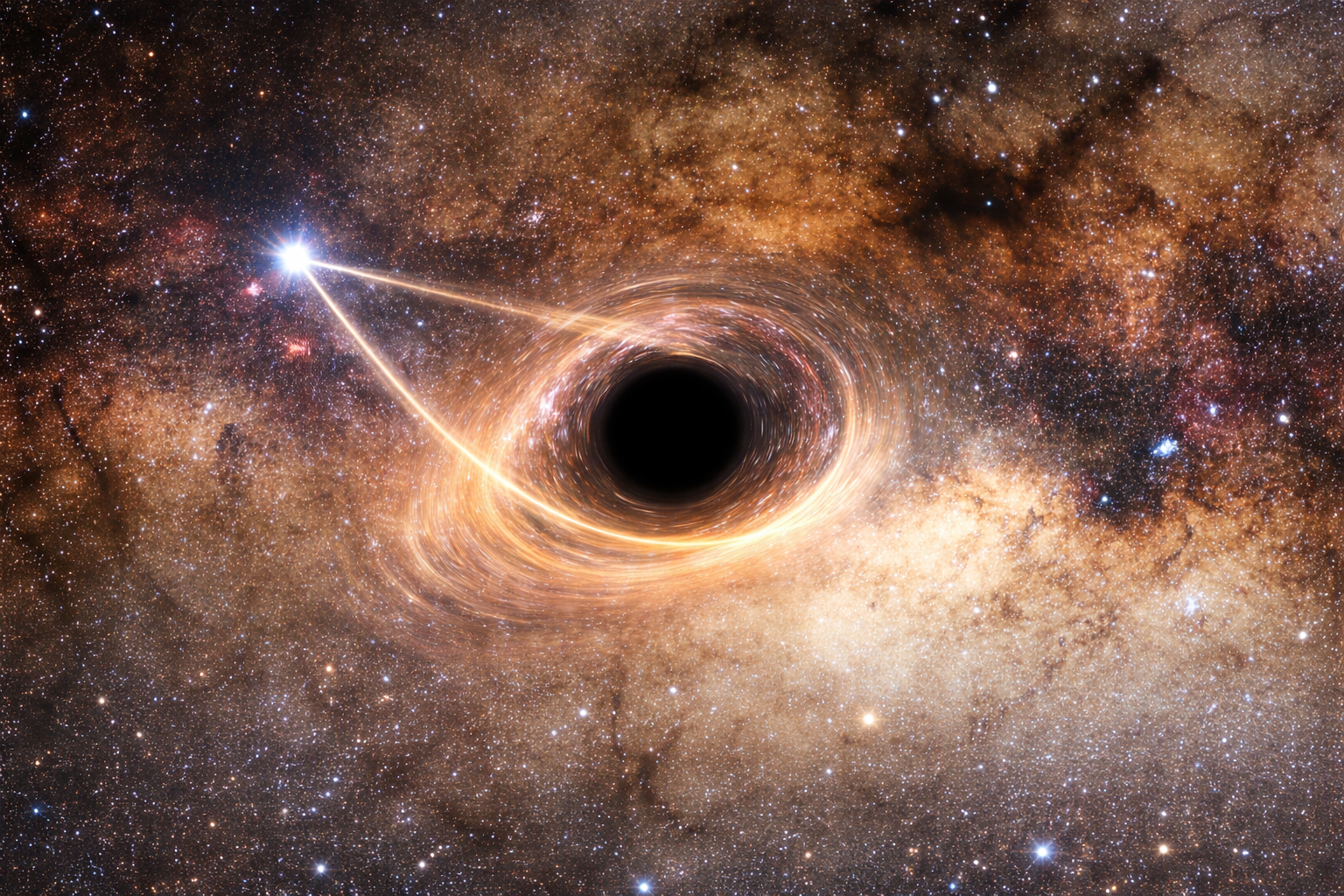
At present, the only viable method appears to be gravitational (micro)lensing. This phenomenon occurs when a black hole passes in front of a distant star and the star’s light is bent due to the distortion of spacetime around the black hole. To an observer, the background (source) star becomes brighter for several months or even years — a phenomenon known as gravitational lensing.
However, lensing events can also be caused by ordinary stars or stars with planets, which are far more common than black holes. Therefore, astronomers must regularly monitor and analyze hundreds of millions of stars in order to identify just a few events that can be attributed to black holes.
By implementing this innovative Polish–Lithuanian project, we aim to discover elusive black holes and other mysterious dark objects that have so far escaped detection. Studying their properties will expand our understanding of exotic objects in the Milky Way.
Within this project, we carry out both photometric and spectroscopic observations, using a global network of telescopes, including facilities in Poland and Lithuania, and we analyze data from the Gaia space telescope. We also make use of data collected during our previous project (2019–2023). Close collaboration with the broader European Gaia community further enhances the project’s value within the European astronomical community.
In 2025, a study published in the journal Astronomy & Astrophysics and led by M. Ban (Poland), titled “AT2021uey: A planetary microlensing event outside the Galactic bulge,” reported the discovery of an exoplanet found using the microlensing method. Co-authors from the Faculty of Physics at Vilnius University include Marius Maskoliūnas, Justas Zdanavičius, Vytautas Čepas, Erika Pakštienė, and Rūta Adomavičienė.
Another study published on the edge of 2025-2026 in the journal Astronomy & Astrophysics led by Uliana Pylypenko (Poland) titled “Constraining lens masses in moderately to highly magnified microlensing events from Gaia.” This scientific article analyzes several microlensing events identified in Gaia data to constrain the masses of unseen lenses that are objects that could include white dwarfs, neutron stars, or other dark stellar remnants. The research team includes many international collaborators, among them Justas Zdanavičius and Erika Pakštienė.
It is interesting to note that discoveries that involved astronomers and instruments from the Molėtai Astronomical Observatory of the Institute of Theoretical Physics and Astronomy (VU), were acomplished thanks to international collaboration. This once again shows that cooperation is an essential part of modern science. Moreover, this marks only the second time in history that Lithuanian astronomers, using telescopes at the Molėtai Observatory, have contributed to the discovery of a new planet.
Scientific papers:
https://arxiv.org/pdf/2503.22331 ir https://arxiv.org/pdf/2504.11546